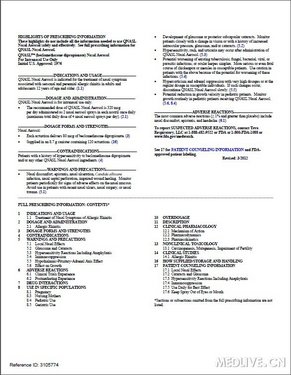

HIGHLIGHTS OF PRESCRIBING INFORMATION
These highlights do not include all the information needed to use QNASL Nasal Aerosol safely and effectively. See full prescribing information for QNASL Nasal Aerosol.
QNASL™ (beclomethasone dipropionate) Nasal Aerosol
For Intranasal Use Only
Initial U.S. Approval: 1976
---------INDICATIONS AND USAGE---------
QNASL Nasal Aerosol is indicated for the treatment of nasal symptoms associated with seasonal and perennial allergic rhinitis in adults and adolescents 12 years of age and older. (1.1)
---------DOSAGE AND ADMINISTRATION---------
QNASL Nasal Aerosol is for intranasal use only.
• The recommended dose of QNASL Nasal Aerosol is 320 mcg per day administered as 2 nasal aerosol sprays in each nostril once daily (maximum total daily dose of 4 nasal aerosol sprays per day). (2.1)
---------DOSAGE FORMS AND STRENGTHS---------
Nasal Aerosol:
• Each actuation delivers 80 mcg of beclomethasone dipropionate. (3)
• Supplied in an 8.7 g canister containing 120 actuations. (16)
---------CONTRAINDICATIONS---------
Patients with a history of hypersensitivity to beclomethasone dipropionate and/or any other QNASL Nasal Aerosol ingredients. (4)
---------WARNINGS AND PRECAUTIONS---------
• Nasal discomfort, epistaxis, nasal ulceration, Candida albicans infection, nasal septal perforation, impaired wound healing. Monitor patients periodically for signs of adverse effects on the nasal mucosa.
Avoid use in patients with recent nasal ulcers, nasal surgery, or nasal trauma. (5.1)
• Development of glaucoma or posterior subcapsular cataracts. Monitor patients closely with a change in vision or with a history of increased intraocular pressure, glaucoma, and/or cataracts. (5.2)
• Hypersensitivity, rash, and urticaria may occur after administration of
QNASL Nasal Aerosol. (5.3)
• Potential worsening of existing tuberculosis; fungal, bacterial, viral, or parasitic infections; or ocular herpes simplex. More serious or even fatal course of chickenpox or measles in susceptible patients. Use caution in patients with the above because of the potential for worsening of these infections. (5.4)
• Hypercorticism and adrenal suppression with very high dosages or at the regular dosage in susceptible individuals. If such changes occur, discontinue QNASL Nasal Aerosol slowly. (5.5)
• Potential reduction in growth velocity in pediatric patients. Monitor growth routinely in pediatric patients receiving QNASL Nasal Aerosol.
(5.6, 8.4)
---------ADVERSE REACTIONS---------
The most common adverse reactions (≥ 1% and greater than placebo) include nasal discomfort, epistaxis, and headache. (6.1)
To report SUSPECTED ADVERSE REACTIONS, contact Teva Respiratory, LLC at 1-888-482-9522 or FDA at 1-800-FDA-1088 or www.fda.gov/medwatch.
See 17 for PATIENT COUNSELING INFORMATION and FDAapproved patient labeling.
Revised: 3/2012